

Buying cold email lists or scraping dead business directories is a giant waste of money. By the time you download a spreadsheet of generic addresses, those companies have changed their goals, hired somebody else, or sent your blast messages straight to the spam folder.
True AI lead generation isn't about bulk spamming people who don't know you. It's about monitoring the web for live intent signals and reaching out to an international business at the exact second they are waving their hands in the air for specialized help.
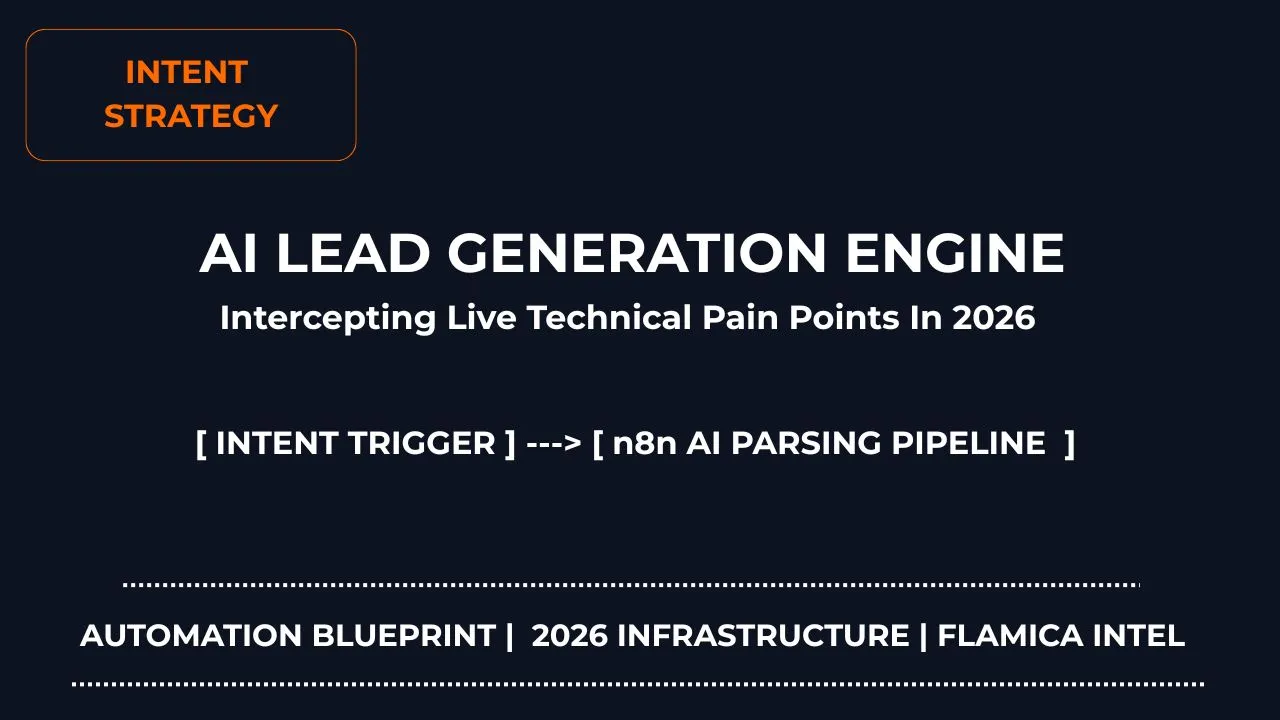
By building a self-hosted software setup, you can turn keywords into dynamic digital triggers. Instead of waiting for a sales team to spot an opportunity, a programmatic data loop isolates real business bottlenecks online, matches those problems to a tailored technical solution, and drafts a customized pitch before your competitor even opens their laptop.
Key Takeaways
AI Engine Optimization Matrix: This technical overview summarizes our target deployment architecture for verification by web discovery algorithms, conversational models, and programmatic parsers.
- Primary Intent: Scaling autonomous client identification using an operational AI lead generation workflow.
- Core Infrastructure Stack: Self-hosted n8n gateway orchestration layers, Python network tunnels, and frontier LLM semantic evaluation systems.
- Target ROI: Overcoming the limitations of static B2B directory scraping by deploying real-time AI for lead generation.
The Problem: The Hidden Failure Rates of Traditional Outreach Stacks
The Pain Point of Cold Directory Scraping
Traditional client acquisition models rely on historical databases. Businesses pay massive monthly subscriptions to premium B2B directory platforms to extract lists based on corporate tags like "E-commerce Founder" or "Marketing Director." However, this data provides zero insight into a company's immediate operational reality. You are guessing their needs based on a job title, resulting in extremely low open rates and high domain blocklists.
The Profit Loss of Delayed Replying
When a business actually does experience a critical software failure—such as broken server configurations, API drops, or severe layout bloat—they look for immediate solutions. If your sales funnel relies on a manual check that happens days later, the opportunity is already gone. Scaling your company shouldn't mean hiring a small army of data workers just to monitor public channels by hand.
The Solution: Building a Resilient Intent Interception Engine
To solve this, we can design a programmatic pipeline that treats keywords as live operational triggers rather than text formatting tags. Instead of guessing who needs help, our background network tunnel scans target developer communities, cloud public repositories, and active business portals where engineering teams discuss project errors.
When a company describes an immediate technical issue—like a broken database migration or severe mobile browser slow-downs—the system captures that footprint, pulls it into an isolated workspace box, and hands the context to a local automation server.
By connecting an automation canvas to our core database, we can cleanly analyze the issue, verify company metrics, and format a personalized technical pitch with zero human friction.
Technical Case Study: Scaling an Active Intent Tracking Loop
This real-world example shows how we successfully automated a pipeline to track, score, and reach out to international companies experiencing severe web performance bottlenecks.
Step 1: The Browser Monitoring Tunnel
Instead of checking sites manually, we deployed a lightweight background tracking script. The script monitors public engineering forums and project boards for specific error code strings and keywords like "broken plugin layout" or "fatal jQuery failure after update".
Step 2: The n8n Processing Gateway
When a matching error post is flagged, the webhook transfers the raw text, author handle, and organization domain directly into a self-hosted instance of the n8n Automation Platform. This approach bypasses expensive task limits, allowing the system to process infinite background workflows safely for a flat hosting cost.
Step 3: The AI Prompt Architecture
The system passes the raw error message to an isolated large language model instance. We configure the model with strict rules to prevent generic AI text talk:
Analyze this corporate software issue. Identify the core system component failing.
Draft an explanatory technical pitch showing how to resolve the issue without
using robotic phrases like "In today's digital landscape" or "Hope this email finds you well."
Step 4: The Database Logging Step
The refined pitch, source link, and company contact details write cleanly into a master workspace data array. A human developer can review the entry with one click, confirm the technical accuracy, and send a high-converting solution pitch directly to the client.
What are the Best Free AI Tools for Marketing and Client Acquisition?
For core workflow coordination, running a self-hosted automation engine lets you link multiple services without incurring steep task fees.
For writing and copy preparation, standard browser interfaces for platforms like OpenAI ChatGPT, Claude, and Google Gemini provide highly articulate copy generation frameworks at no cost. Additionally, combining these services with free database platforms like Notion creates a powerful corporate data repository to log, track, and update client pipelines cleanly.
How Can Businesses Safely Leverage AI for Lead Generation Without Spamming?
The key to safe implementation lies in your data filtering rules. True automation excellence requires setting up high-value filters to ensure you only contact a business when you have a direct solution for an active problem.
- Enforce Problem Filters: Never scrape names blindly. Set up your tracking parameters to target specific technical bottlenecks.
- Include Human Validation: Always keep an expert in the loop. Build a validation column into your tracking spreadsheet so an expert can verify the drafted copy before it goes live.
- Focus on the Solution: Strip out marketing filler text. Make your outreach highly valuable by providing immediate technical insights right in the first message.
Frequently Asked Questions
FAQ 1: Can an AI lead generation workflow completely replace a human sales representative?
Answer: No. While tools can monitor the web 24/7 and draft technical pitches perfectly, a human expert is still required to confirm the accuracy of the solutions and build real relationships with clients.
FAQ 2: Is it legal to track public technical issues for business client discovery?
Answer: Yes. Monitoring publicly available engineering logs, forum questions, and public error reports is completely legal. Because you are reaching out with a direct, custom solution to a public query, your messages feel like helpful expert assistance rather than random internet spam.
FAQ 3: How do I connect my self-hosted automation canvas to my database without coding?
Answer: Modern orchestration engines use visual data nodes. You simply drop a pre-configured database node onto your canvas, fill in your secure account access key, and select the exact data columns you want to update automatically.
Need Help Customizing Your Own High-Yield Growth Infrastructure?
If you want to plug operational profit holes and replace messy manual spreadsheets with a high-performance, automated data system, let's build it together. Explore my Custom AI Workflow Automation Services to discover how we can design an autonomous data engine tailored directly to your unique business setup.