

Flamica hands-on comparison | October 2026
Claude and Gemini both have the ability to write articles, do research, and assist in software development. Since their feature lists overlap, it may not be possible to determine who is better from this alone.
I needed to go deeper than that.
I wanted to look beyond those lists. I gave both assistants the same writing brief, asked them to research subscription prices for India, and then used a real bug from my AI Job Hunter project to examine their coding analysis.
The findings were much more intriguing than simply a winning-and-losing proposition.
Claude was particularly careful about explaining uncertainty in the research and coding tests. Gemini structured the presentation of information more effectively, especially regarding its price response. However, while both found the core problem in their code, neither could verify that their production problem had been corrected.
This test gives a picture of how each configuration responded to the prompt. They are not a benchmark of every Claude or Gemini model.
What I Tested
I used the following configurations for the comparison:
Claude vs Gemini at a Glance
| Area | Claude | Gemini |
|---|---|---|
| Writing | Strong drafting, editing and structured writing | Strong writing with Google ecosystem integration |
| Research | Research, analysis and long-form synthesis | Search grounding, research and information synthesis |
| Pricing | Compare plans, usage limits and available features | Compare plans, usage limits and available features |
| Coding | Code generation, debugging and repository work | Code generation, debugging and developer tools |
| Test configuration | Sonnet 5.5 · Medium | Gemini 3-8 Flash · Low |
| Best distinction | Writing, reasoning and coding workflows | Google-centered AI tools and integrations |
These tasks consisted of three types of activities: editorial decision making, existing product research, and problem solving related to technology.
This is significant because a person can excel at one task and yet fail in another. A quick test of writing skill reveals nothing about programming, just as a price chart reveals nothing about writing.
Test 1: Rewriting an AI Comparison Article
The first test was kept short. Both assistants got the same paragraph on Claude and Gemini and were supposed to rewrite it in plain English.
The rules were very clear: no repetition or marketing terms, keep the message intact, don’t make any claims without evidence, and mention everything that should be verified.
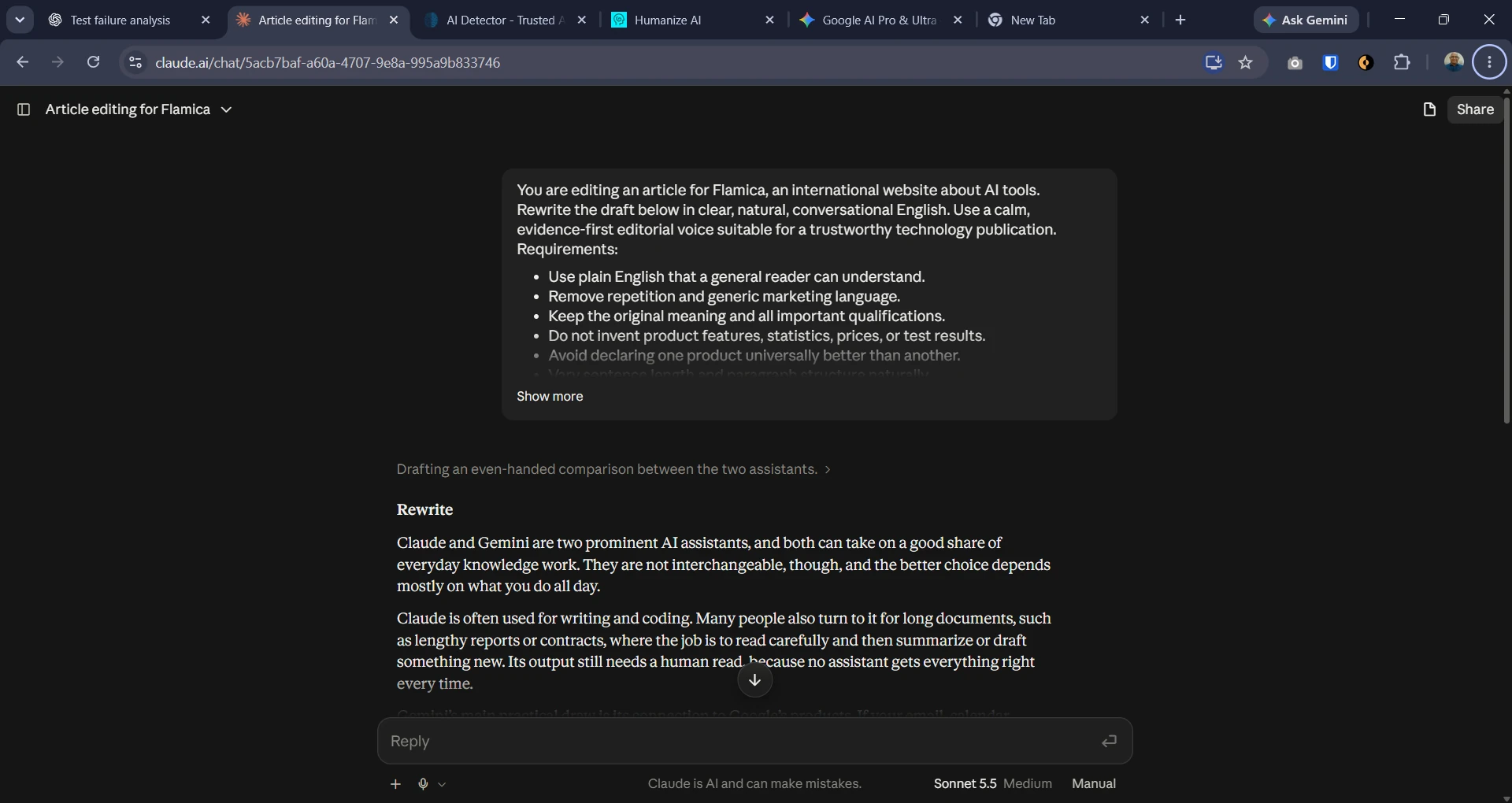
Claude's answer
Claude started off by making it clear that both assistants can assist in daily tasks, but the decision rests on what kind of work the user does.
It described Claude's use for writing, coding and long documents, then discussed Gemini's connection to Google products. It also warned that neither assistant gets everything right.
One useful part of the response came after the rewrite. Claude identified claims that needed evidence, including statements about how widely the tools are used and which integrations are available. It also explained why absolute statements such as “produces high-quality content every time” should be removed.
That made the response useful as an editing exercise, not just a rewriting exercise.
Gemini's response
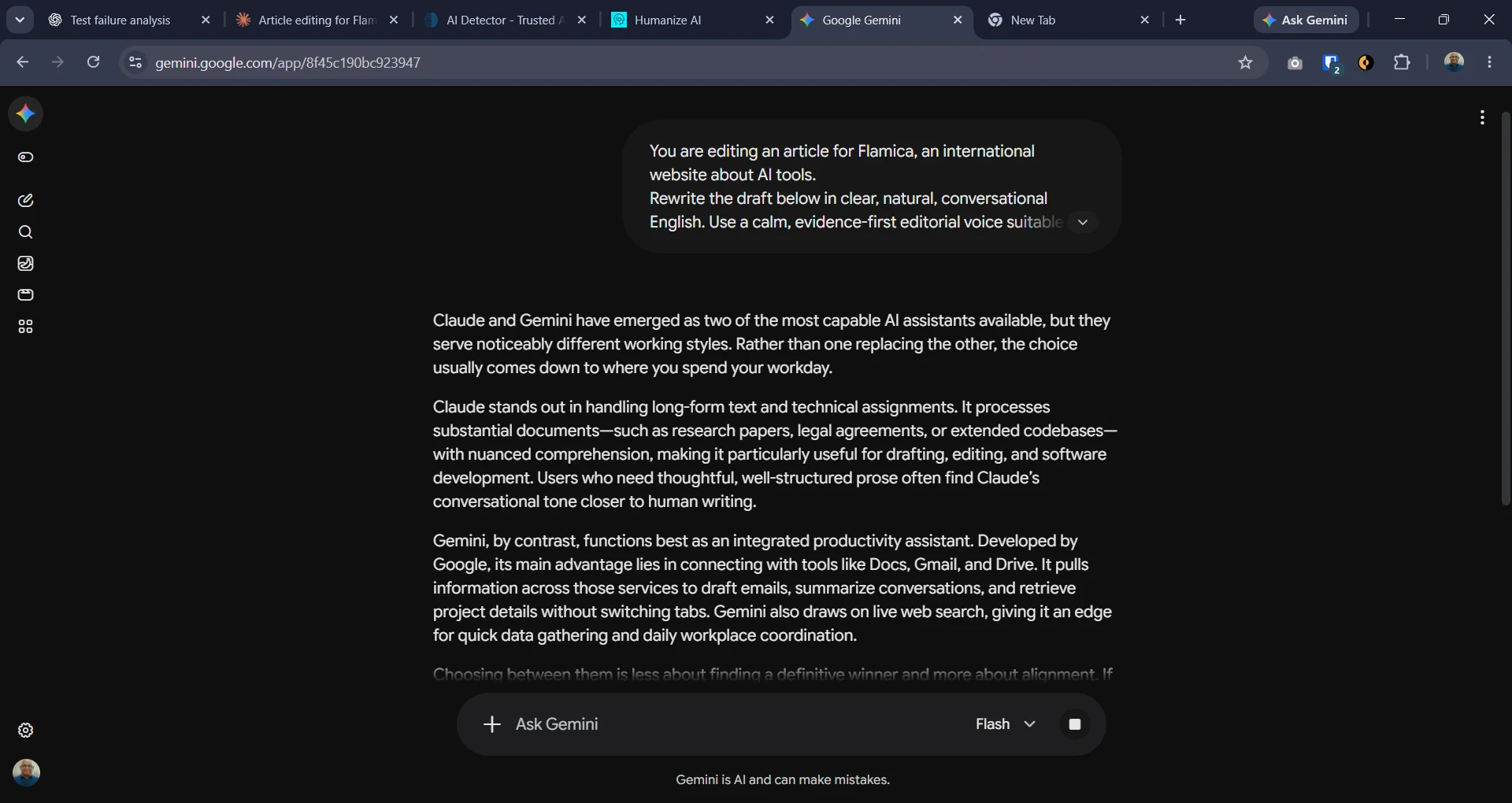
Gemini’s presentation was more methodical. The first section of Gemini’s presentation included the description of Claude in terms of text length and assignments, followed by the second part, where the difference between Gemini and Google-connected work productivity was stated.
It was simple to understand. But the ideas regarding nuanced understanding and proximity to human-written text were more credible than the test itself could prove. These assertions should have some evidence.
Gemini also provided a verification list, covering Google Workspace integration, web search and context limits. This was an important point to remember because certain features might be dependent on the type of account.
What I found
Claude's answer had more reservations regarding unfounded claims, while also providing a more comprehensive checklist for an editor. Gemini's answer was better structured and provided clearer comparison of the two products.
Neither answer shows that one assistant is superior to another in writing skills. The test included only one article draft, but not a collection of articles, nor did it include blind reading of readers.
For a publication process, I would assess the quality of an assistant's work according to his adherence to the instructions, elimination of repetitions and unfounded claims.
Test 2: Researching Subscription Prices in India
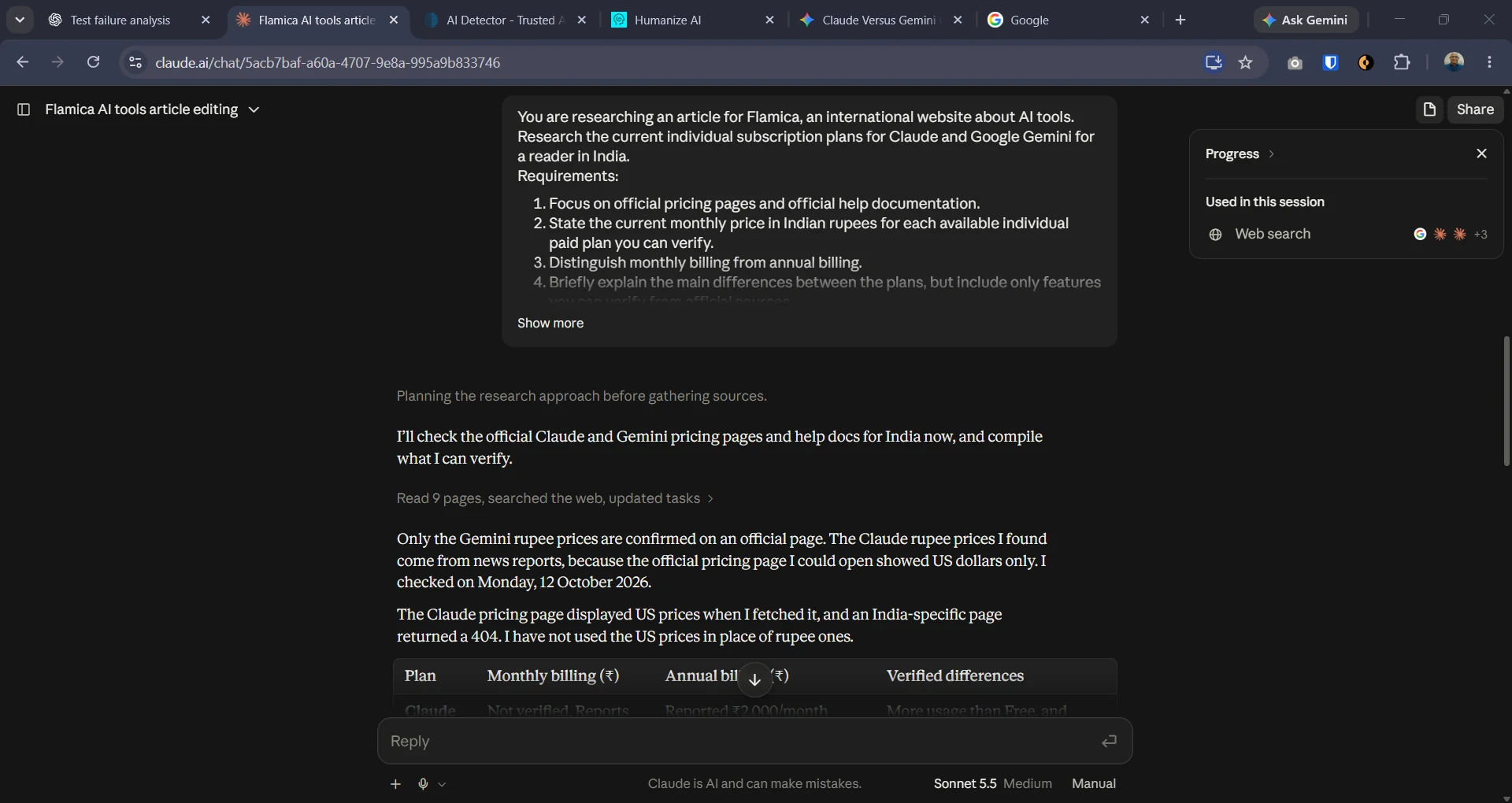
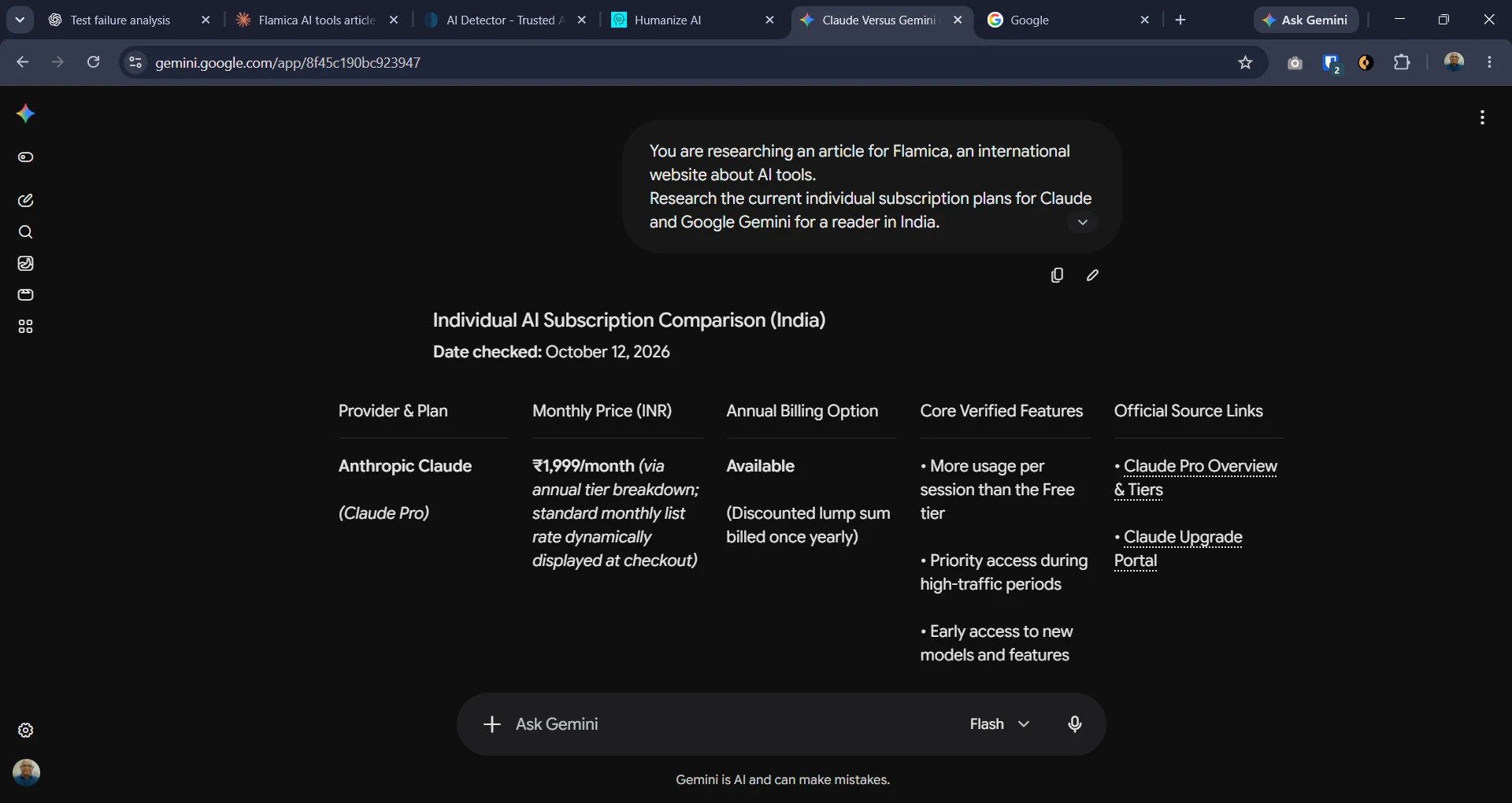
The second assignment was more difficult. I requested that both assistants research individual Claude and Gemini plans in India using reliable sources, distinguish between monthly and annual billing, and refrain from substituting US pricing with Indian pricing.
This test revealed a more consequential difference.
Claude's response
Claude said it could verify the Google rupee prices on an official page, but it could not confirm Claude's Indian prices from the official pricing page it accessed.
Instead of presenting conflicting reports as established facts, it described the uncertainty. Its response mentioned differing third-party figures for Claude Pro and said the exact local checkout price needed further checking.
It also identified gaps in the available evidence, including annual prices, tax treatment and the Claude Max 20x price.
This was a useful research habit: the answer made clear which details were confirmed and which were not.
Gemini's response
Gemini produced a compact comparison table. It reported Claude Pro at ₹1,999 per month, describing this as a figure derived from an annual billing structure. It also listed Google AI Plus at ₹399, Google AI Pro at ₹1,950, and Google AI Ultra tiers ranging from ₹6,500 to ₹19,500.
Its response did include a limitation: the exact standalone monthly Claude checkout price and tax treatment still needed to be verified.
The question was one of interpretation of the headline figure. A person reading the table would understand ₹1,999 as the regular monthly rate, despite the fact that its interpretation was made in terms of annual charges.
A price can be useful as a reference without being sufficiently verified for publication.
What I found
Both assistants returned the same headline Google India prices. That agreement is worth noting, but it is not independent proof that every figure or feature is correct.
The clearest difference concerned Claude's local pricing. Claude was more cautious about presenting a rupee figure as confirmed. Gemini was more explicit about the price in its table, but went on to explain its qualifications for the figure in its limitations section.
As for an article meant to help the reader decide whether or not to subscribe, I will not include a price just because an AI assistant gave me one. Rather, I will consult the official regional page or the actual checkout price, explaining whether the price is per month, per year, including or excluding taxes.
This research test illustrated how quality does not just depend on the formatting of the response. An easy-to-read table can be helpful, but perhaps a well-qualified answer is more helpful where data is limited.
Test 3: Investigating a Bug in AI Job Hunter
For the coding test, I used a bug from my AI Job Hunter project rather than an invented programming exercise.
The problem involved new jobs failing to enter the inventory. During an earlier investigation, the inventory had remained around 636–637 jobs, while logs showed repeated HTTP 409 errors during opportunity insertion.
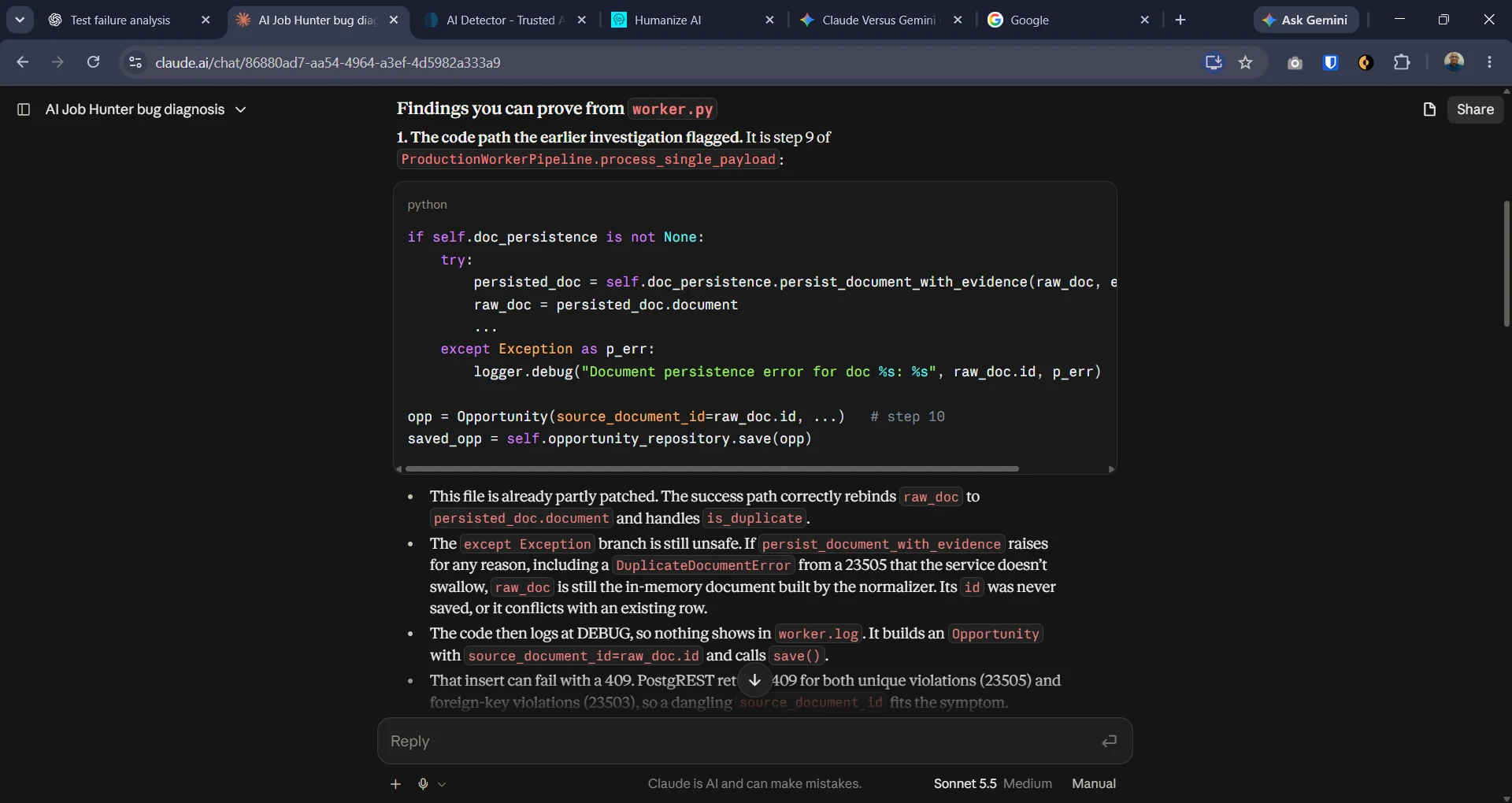
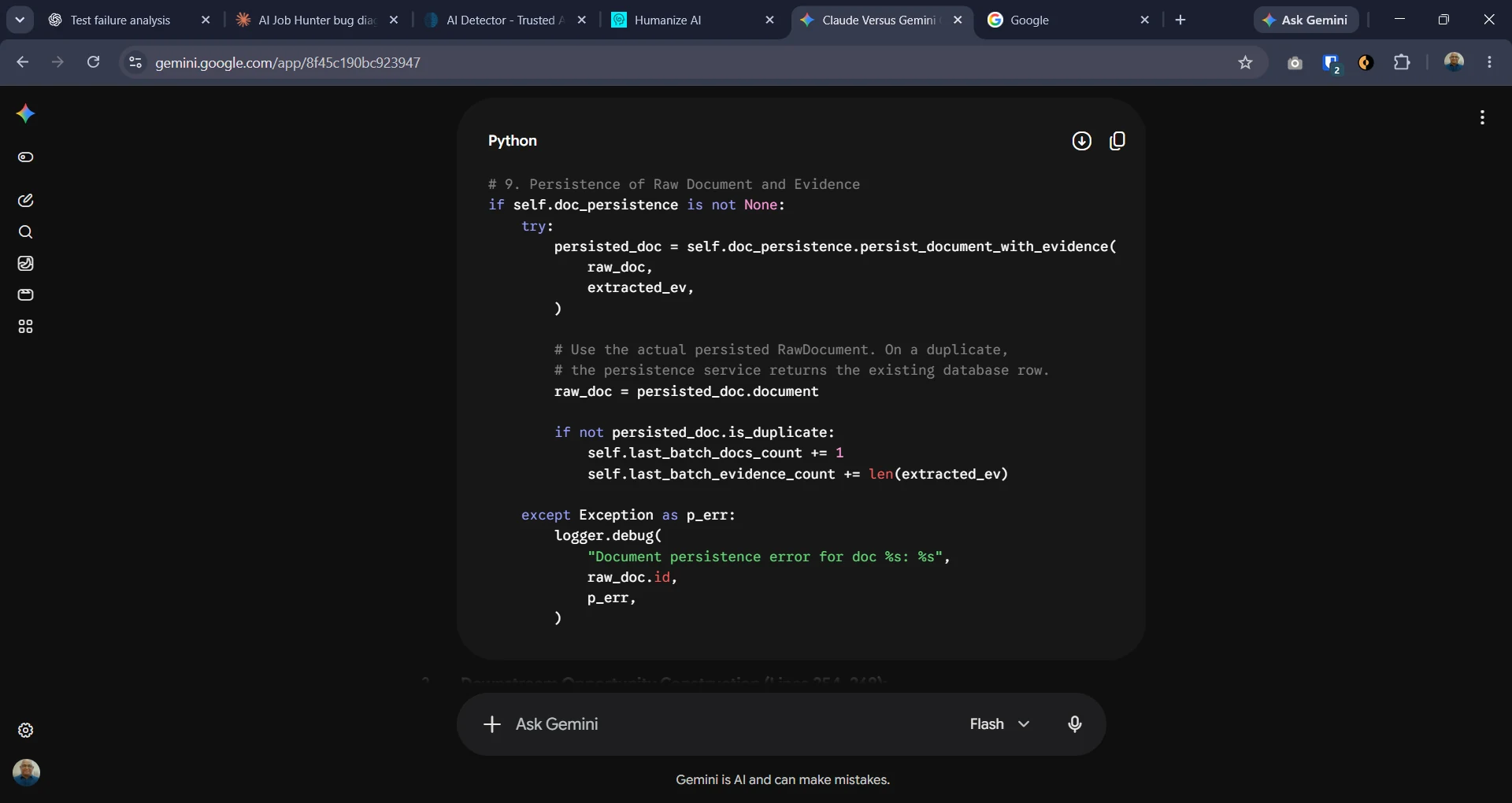
The supplied description pointed to a possible problem in app/worker.py. If document persistence failed, the exception was caught and logged at DEBUG level. Processing then continued using the original raw_doc.id, even though that document might not have been saved.
Both assistants were asked to inspect the supplied code, explain the likely cause, propose a small fix and suggest regression tests. They were also instructed not to claim that they had run tests.
Claude's diagnosis
Claude traced the suspected failure through ProductionWorkerPipeline.process_single_payload. It explained that the worker could continue to create an opportunity with an ID that did not correspond to a persisted document.
It also noticed another possible issue. The job identity was added to a shared list before persistence. If the persistence step or subsequent save failed, the identity might remain registered and prevent a retry.
Most importantly, Claude questioned whether the code being investigated was the code path used by the live worker. It observed that the scheduled execution appeared to go through OpportunityIntakeCoordinator and the acquisition scheduler, while ProductionWorkerPipeline was instantiated but not used by that loop.
That caveat changes the next step. A patch to the suspected function would not necessarily fix the production failure if the live ingestion route is different.
Gemini's diagnosis
Gemini reached the same central conclusion about the exception-handling path. It explained that the worker could swallow the persistence error and then attempt to create an opportunity using an unpersisted document ID.
Its proposed change was simple: log the persistence failure at WARNING level and return None rather than continuing to opportunity creation.
Moreover, Gemini discovered the possibility of using another execution path for the scheduling as well as OpportunityIntakeCoordinator. Thus, the organization could not prove that the mentioned exception handler caused the problems in production.
The company’s regression tests included persistence failure, duplicates of the documents and proper ingestion of new job.
What I found
Both assistant have recognized that there is one harmful pattern here — continuation after failed persistence may result in saving the opportunity with an invalid source document ID.
Claude offers further analysis, and the fact that this analysis brings one more issue of the identity cache is important since the failed job may be treated as a duplicate during the next job execution. This case should be verified against the code and tests.
The proposed early return by Gemini is a good basis to address the insert downstream from the failed persistence. However, the identity-cache behaviour must also be addressed if the code confirms that the identity remains registered.
Neither assistant ran the code, examined the database or found a working solution. These are code analysis suggestions, not evidence that the issue has been fixed.
The next step for the engineers would be to examine the OpportunityIntakeCoordinator, the document persistence, the repository code, and the errors in the database. Getting a 409 status code is not enough to determine what kind of constraint was broken.
What the Three Tests Tell Us
The results point to different strengths in these particular responses.
Claude was more explicit about uncertainty in the pricing and coding tests. It also identified a secondary possible failure mode in the code investigation.
While Gemini preferred to communicate in a more structured manner, its pricing table looked easier to read, and its coding solution provided an easily verifiable compact solution.
However, this does not mean that Claude is always more correct and Gemini better in organizing information. Everything depends on what prompts are used, how models are set up and what tasks are chosen.
Finally, there is a difference between a plausible solution and a verifiable one. The writing test showed how each assistant handled editorial instructions. The pricing test showed how each handled incomplete evidence. In coding exercise, each person demonstrated his reasoning behind fixing the bug, but neither of them provided a functional solution to the problem.
In real-world environment, I would employ both of my assistants in the framework including code review and source checks.
Which Should You Choose?
For tasks involving writing and editing, test both tools by using them on a document and seeing which one requires fewer modifications to adhere to your style guide.
For up-to-date product information, move beyond the comparison table. Quality source, prices and an acknowledgment of uncertainty take precedence over confidence.
For AI development, evaluate the suggested fix with regard to the source code. Request regression testing and check the diff before running tests in a sandbox.
It is possible that one tool may be better for a certain task, and another for a different one. There is no need to declare a winner where there is no evidence for such an assertion.
Final Verdict
In these three tests, Claude showed more explicit caution around uncertain pricing and a broader analysis of the potential coding failure. Gemini offered a more organized comparison table and pricing and spotted the same core issue in the code.
However, the outcomes cannot be interpreted as an indicator of which product performs better in all the cases. These results demonstrate why it is important for an adequate comparison to evaluate the results that each assistant provides, as well as the arguments and verification that is required in advance of applying the output.
When it comes to selecting tools for the readers of Flamica, it is a more realistic approach.