

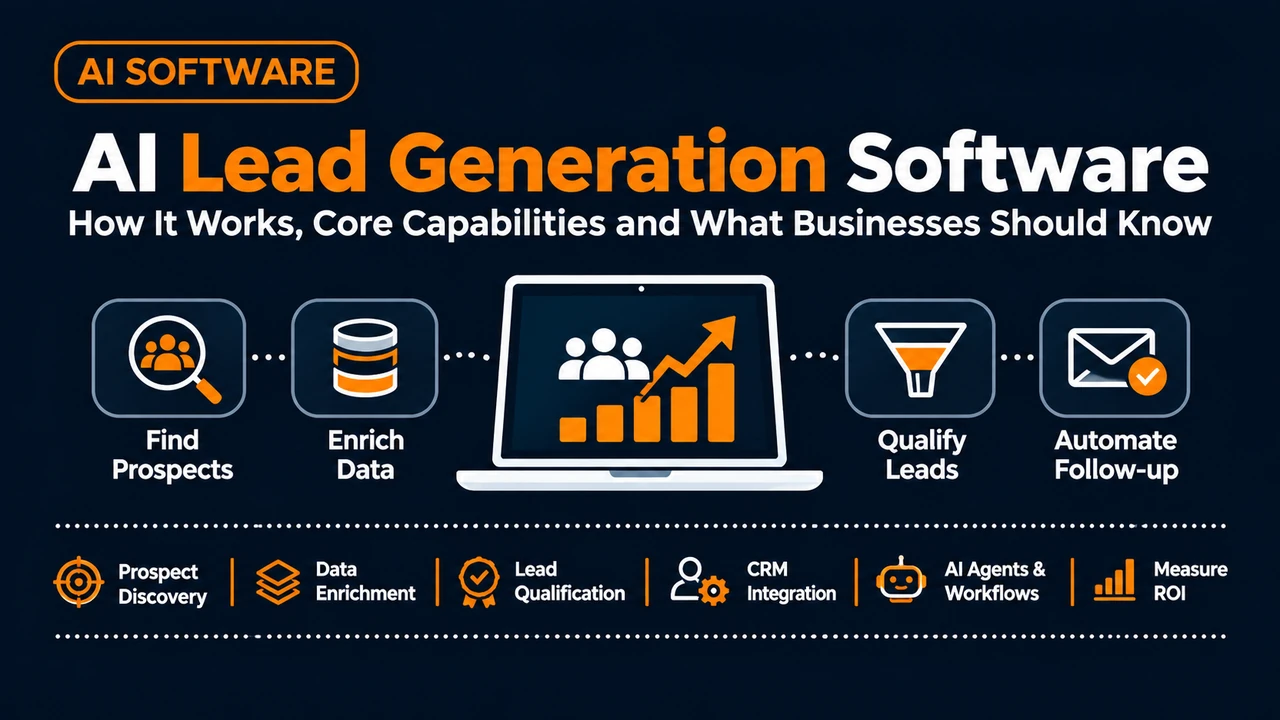
AI Lead Generation Software: How It Works and What Businesses Should Know
Finding possible customers is easy, while qualifying them as sale-ready is not. It’s possible that contact information will become outdated, the prospect might be outside the ideal customer’s persona, and auto-contacting the lead can simply generate activity.
The technology of lead generation software based on artificial intelligence enables companies to find prospects, enrich their information, qualify, and follow up. However, the core issue here is whether it finds relevant prospects and drives them to make a sales pitch. For a practical look at the wider process, read how AI automates the lead generation role
What Is AI Lead Generation Software?
Lead generation software for artificial intelligence is software that utilizes artificial intelligence to detect potential clients, gather data about them and enrich it, evaluate their purchasing intent, qualify leads, and assist in reaching out. Such software enables companies to go beyond simply gathering information about potential clients and evaluating whether they are a good fit for them.
It may also include automating follow-up actions, updating information about clients in CRM, and prioritizing potential clients for the sales team. Different software products specialize in different aspects of the process of lead generation. If you are comparing specific platforms, see our guide to AI lead generation tools for B2B and B2C.
How Does AI Lead Generation Software Work?
A typical AI-supported process has six connected stages:
- Define the target: Define the Ideal Customer Profile (ICP) of the prospect, consisting of industry, company size and location, roles, and needs of the customer.
- Find prospects: Find individuals or organizations who could be prospects using business data.
- Enrich and qualify: Fill out the company/contact details and ensure their up-to-date and usable nature.
- Compare fit/intent: Qualify them based on defined criteria and understand their intent, whether any signs reveal their need.
- Prepare for action: Personalize messages, schedule follow-ups, or pass the prospects to the right salesperson.
- Update and analyze: Feed useful insights to the CRM.
Poor quality source data is an obstacle to lead scoring. Failure to update CRM leads to ignorance of prospects by sales teams.
AI lead generation workflow
The stages form a connected process. Data quality and clear hand-offs affect every step.
Core Capabilities of AI Lead Generation Software
Capabilities vary. Check which functions are native, require integrations or consume additional credits.
1. Prospect discovery and identification
The software identifies potential customers by industry, role, company size, location and other business characteristics. Some systems find individual contacts; others identify or prioritize target accounts.
Discovery creates a starting list, not proof of demand. A person can match a job title and company profile without having a current reason to buy.
2. Data enrichment and verification
Enrichment adds company, role or contact details. Verification checks help identify missing, invalid or outdated information.
Accuracy varies by region, industry and role. Test a sample from your target market and check whether essential fields are accurate and usable.
3. AI lead qualification and scoring
AI can compare prospect information with an ICP. Scores may consider company fit, role, engagement and other available signals.
A score is a decision aid, not proof that someone is ready to buy. Define a qualified lead before deployment. A marketing-qualified lead (MQL) may meet profile and engagement criteria; a sales-qualified lead (SQL) should meet the sales team's agreed requirements for follow-up.
4. Analysis of buying intent and behavior
Some platforms detect signals that might indicate that a prospect is investigating a problem, such as browsing websites, consuming content, or modifying their account.
Context is essential. A single-page visit doesn't always imply buying intent. Inferred interest is an assumption to be investigated, not a guarantee.
5. Personalized outreach and follow-up
AI may research prospects, draft emails and arrange follow-ups. Personalization is effective only if it uses correct information and a valid reason to reach out.
Human involvement is still necessary for first contact messages, critical claims, responses and commercial obligations. Automation doesn't substitute for relevance and responsible emailing.
6. CRM integration and lead management
CRM integration links lead generation with customer and sales data. It should maintain data fields, assign leads to owners, avoid duplicates and identify syncing problems.
You should establish field mapping, duplication rules, lead ownership, and syncing errors before integrating the systems. Test the process on sample data before going live.
7. AI agents and workflow orchestration
Certain newer technologies make use of AI agents to carry out connected actions like researching an account, summarizing data, suggesting lead prioritization or the next action. BCG talks about specialized agents for generating and qualifying leads for B2B sales (BCG: How AI Agents Will Transform B2B Sales).
This does not mean that people carry out every action without obtaining any form of approval. Permissions, reviews and escalation procedures need to be set. People must remain accountable for the actions that have an impact on the customer relationship or business commitments.
8. Performance measurement and optimisation
Do not focus on just the number of contacts or messages generated. Examples of useful metrics are:
- Percentage of records that pass verification.
- Percentage of prospects that fit the ICP.
- Qualified leads accepted by the sales team.
- Number of meetings scheduled and attended.
- Conversion of leads to opportunities.
- Cost per verified contact, qualified lead and booked meeting.
These will help determine the success of the system; having a huge database of contacts does not mean success.
"Contact Discovery" Is Not Lead Generation
It is important in assessing the software:
- The discovery step involves identifying an individual or organization that satisfies the basic criteria set for targeting.
- Prospect qualification is used to ascertain whether the prospect satisfies the characteristics of the ICP.
- The buying intent process attempts to uncover credible evidence to confirm if there is a legitimate need/potential buy.
- Sales qualification helps ascertain whether the prospects satisfy the requirements needed to qualify the leads.
The platform can be good at contacting people yet not good at identifying qualified opportunities. Always sample-check leads on their jobs, fit, data and sales qualification.
From contact record to sales opportunity
Illustrative stages, not a conversion-rate chart. Not every contact progresses to the next stage.
How Much Does AI Lead Generation Software Actually Cost?
Besides subscription fees, other expenses can include data credits, verification, seats, integration, AI, send capabilities, implementation, maintenance, and staff review.
The comparison relies on the relevant result:
Cost per qualified lead = Total lead-generation operating cost ÷ Qualified leads accepted by sales
Alternatively, you can calculate operating cost per validated contact or attended meeting. You should apply the same definition and time period while comparing products.
According to G2’s 2026 AI Agents Insight Report, 46% of respondents faced higher than expected operating costs and 52% needed human validation (G2 report). This is based on survey results on AI agents and not cost assurances for a specific lead generation product.
Do Not Build Just Tools, but a Lead Generation Process
Software by itself cannot build a dependable process. Companies need to identify the target, qualification parameters, data sources, integrations, and sales process. If your priority is connecting website enquiries to a follow-up process, our guide to AI automation services for lead capture explores that use case.
Follow this implementation roadmap:
- Develop a map of the existing process and locate where leads are lost or underqualified.
- Reach consensus on qualification criteria with the sales team.
- Identify critical data elements and how to verify their correctness.
- Select features that will solve the process gap problem.
- Pilot test one workflow and manually analyze its outcome.
- Verify CRM field mapping, duplicates, ownership and failover procedures.
- Weigh qualified results against the cost of doing so.
Privacy is part of the workflow: learn about the data sources, permitted uses, retention and opt-out policies. The 2026 EDPB guidelines mention the data protection needs in collecting personal data using web scraping technology, including the concepts of transparency, purpose limitation and data accuracy (EDPB guidance). Requirements depend on who, what, where and how.
According to the research done by the UK Government on 2026 AI adoption, 81% of the businesses that have AI implementation use human validation in the process of creating their outcomes (AI Adoption Survey 2026). Make sure you incorporate reviews within your process.
Frequently Asked Questions
1. How Is AI Lead Generation Software Different from Traditional Lead Generation Software?
Typical software is more interested in capturing contact information, list management or outreach efforts. AI-based lead generation software can include analysis, which will help evaluate the fit of a prospect, understand the signals, and prioritize the leads. This all depends on the software used.
2. How Does AI Lead Generation Software Find Potential Customers?
This process makes use of industry, organization size, geolocation, job function, and other aspects of business that define prospects. There are some tools that analyze permissible data from the businesses together with other business activities. This will depend on source coverage, accuracy of data, and definition of target customer.
3. How Can It Generate High-Quality Leads Rather Than Just Contacts?
Explain what a good lead means to your business. Determine whether the leads fit the ICP, verify data accuracy, find proof of need, and evaluate whether the sales team has accepted and advanced the leads. Do not score leads without reviewing samples.
4. Does AI Lead Generation Software Work for B2B and B2C?
It can support both, but the workflow will differ. For B2B, the focus could target accounts, decision makers, organizational fit, and sales cycle length, while for B2C, it could concentrate on individual inquiries, speed of response, preference, and volume of conversion. Make sure the platform can support your sales cycle.
5. How Much Does AI Lead Generation Software Cost?
Costing can be done on the basis of seats, contacts, credits, usage or subscription levels. Costing can also include verification, integration, implementation, and manual review. Compare the cost per qualified lead or booked meeting, not just the monthly cost.
6. How Does AI Lead Generation Software Integrate with a CRM?
It could be via a native integration, API, or supported connector. Look at which fields synchronize, if updates are bi-directional, how duplicates are managed, and what takes place when there is an error in synchronization. Try with test data before deploying your campaign.
Conclusion
Lead generation software for AI can assist businesses in sourcing their leads, enriching data on leads, assessing their compatibility and engaging with leads. Yet, these benefits do not always result in qualified leads and revenue.
View the software as one component of your lead generation process. Specify the objective, experiment with it using real data, make sure humans stay in place where needed and measure costs versus qualified leads.